Arabic
  French
  German
  Indonesian
  Italian
  Portuguese-brazilian
  Simplified-chinese
  Spanish
  Thai
Thai  Traditional-chinese
  Turkish
  Vietnamese

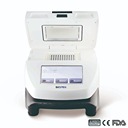
| Name | Thermal Cycler, Touch Screen |
| Code | scitek-0845 |
| Type | Standard |
| Brand | Scitek |
| Category | PCR Analyzer and Pretreatment |
| subcategory | Thermal Cycler |
| Unit | pcs (pcs) |
| In Stock | Yes |
| Berminat hub kami: |  |
Sample Capacity : 96x0.2mL PCR tube; 8x12 PCR plate or 96 well plate
Heating Temperature Range : 4-105℃
Max. Heating/Cooling Rate : 3℃/Sec
Size (W×D×H)(mm) : 280x370x250
The PCR-TCG thermal cycler is a compact, accurate and economical thermal cycler designed to meet your laboratory's basic thermal cycling needs.
Thermal Cycler Specifications:
| Model | PCR-TCS |
|---|---|
| Sample Capacity | 96x0.2mL PCR tube, 8x12 PCR plate or 96 well plate |
| Heating Temperature Range | 4-105℃ |
| Lid Temperature Range | 30-110℃ |
| Temperature Display Accuracy | ±0.1℃ |
| Temperature Control Accuracy (at 55℃) | ±0.3℃ |
| Temperature Uniformity(at 55℃) | <0.3℃ |
| Max. Heating/Cooling Rate | 3℃/Sec |
| Adapter Block Material | Aluminum |
| Display | 7'' LCD 800×480 |
| Input | Touch panel |
| User Defined File System | Max. 30 segments 99 cyclesmax. 16 folder and 16 files each folder |
| Power off Protection | Yes |
| Power Supply | AC100-120V/200-240V, 50/60Hz |
| Size(W×D×H)(mm) | 280x370x250 |
| Shipping Size(W×D×H)(mm) | 620x440x460 |
| N.W./G.W. (kg) | 11.6/15 |
Thermal Cycler Features:
The PCR-TCS thermal cycler is equipped with a capacitive touch screen for easy one-touch parameter setting and viewing of test results. It is suitable for biotechnology, genotyping, cloning, mutagenesis and sequencing.
High-performance DSP enables faster processing of data in PCR reactions, improving reaction speed and accuracy.
Temperature control algorithms can respond faster to temperature changes to accommodate different types of PCR reactions, including standard PCR, real-time quantitative PCR, digital PCR, and more.
Excellent temperature uniformity reduces these deviations and improves the consistency and comparability of PCR reaction results.
Rapid heating and cooling rates for great savings in experiment time.
Innovative heating/cooling elements enable uniform temperature distribution, avoiding hot and cold spots.
Energy consumption is saved through more efficient energy conversion and temperature regulation mechanisms. This helps to reduce experimental costs and is environmentally friendly.