Arabic
  French
  German
  Indonesian
  Italian
  Portuguese-brazilian
  Simplified-chinese
  Spanish
  Thai
Thai  Traditional-chinese
  Turkish
  Vietnamese

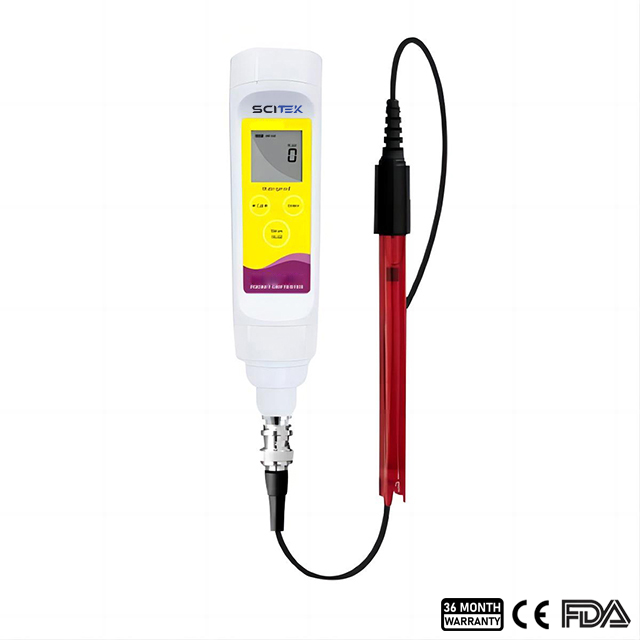
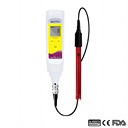
| Name | Pocket ORP Tester |
| Code | scitek-0347 |
| Type | Standard |
| Brand | Scitek |
| Category | PH And Electrochemistry |
| subcategory | ORP Tester |
| Unit | pcs (pcs) |
| In Stock | Yes |
| Berminat hub kami: |  |
Range : ±999mV
Accuracy : ±2mV
Calibration Points : 1 point
Sizes(W×D×H)(mm) : 185(L)x40(Dia.)/175(L)x40(Dia.)
Pocket ORP Tester Specifications:
| Model | ORP-B10 | ORP-B20 | |
|---|---|---|---|
| ORP | mV Range | ±999mV | ±999mV |
| Relative mV Range | ±999mV | ±999mV | |
| Resolution | 1mV | 1mV | |
| Accuracy | ±2mV | ±2mV | |
| Calibration Points | 1 point | 1 point | |
| Other Specification | Sensor Type | E-ORP scan-S ORP electrode | 5 series ORP electrodes |
| Sensor Material | Platinum sheet | Platinum pin or platinum band | |
| Connector | —— | BNC | |
| Hold Function | Manual or auto-endpoint | Manual or auto-endpoint | |
| M | 8 minutes after last key pressed | 8 minutes after last key pressed | |
| Operating Temperature | 0-50°C | 0-50°C | |
| Display | Dual-line LCD (21×21 mm) | Dual-line LCD (21 x21mm) | |
| Power Requirements | 2×1.5V AAA batteries | 2 x1.5V AAA batteries | |
| Battery Life | Approximately 200 hours of continuous use | Approximately 200 hours of continuous use | |
| Sizes(W×D×H) | 185(L)x40(Dia.) | 175(L)x40(Dia.) | |
| Shipping Size (W×D×H)(mm) | 220x110x70 | 280x80x250 | |
| N.W./G.W. (kg) | 0.1/1 | 0.1/1.5 | |
Pocket ORP Tester Features:
These are two economical, multi-purpose pocket ORP testers with BNC connectors that can connect to various ORP electrodes. It is suitable for measuring the redox potential value of samples. The following are the features and applications of the pocket ORP tester:
It is waterproof and can be used in harsh environments.
Power off automatically when not in use for a long time, which is more energy-saving.
Relative and absolute mV measurement modes.
Automatic power off, saving battery power consumption.
Automatic endpoint lock, retaining stable readings, easy to view and record.
Applications of Pocket ORP Tester:
To sterilize water, I am detecting chlorine dioxide, chlorine, or ozone in aquariums or swimming pools.
Measurement of pH levels in sewage effluent.
Water quality testing in aquaculture.
Industrial applications such as pulp bleaching, drinking water testing, etc.